|
UnnamedOS
|


|
|
UnnamedOS
|
|
Syscall Interface. More...
 Collaboration diagram for Syscall:
Functions | |
| static void | syscall_exit (uint32_t return_value, uint32_t ecx, uint32_t edx, uint32_t esi, uint32_t edi, cpu_state_t **cpu) |
| Exits the current task. More... | |
| static uint32_t | syscall_getpid () |
| Returns the current task's PID. More... | |
| void | syscall_init () |
| Initializes the syscall interface. | |
Syscall Interface.
This defines the syscall interface used in user-space to access kernel functions. Syscalls may have up to 5 arguments and a return value. They are called by firing a 0x30 interrupt with a syscall ID placed in EAX. Parameters are placed in general purpose registers, the return value in EAX.
|
static |
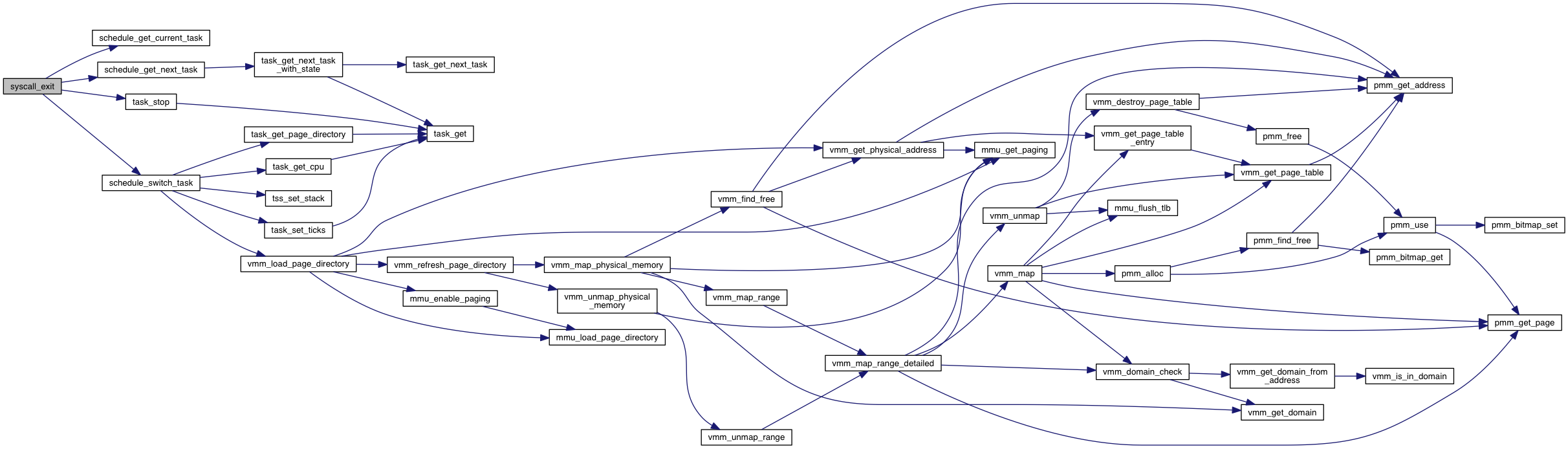
Exits the current task.
| return_value | whether the task returned successfully (0) or not |
| ecx | ignored |
| edx | ignored |
| esi | ignored |
| edi | ignored |
| cpu | the CPU state pointer so we can switch to the next task |
We tell the scheduler to not switch to this task again, so we can properly free it later in schedule_finalize_tasks(). We can't do that here because we are operating on this task's kernel stack which we cannot free while it is still in use.
Definition at line 29 of file syscall.c.
Here is the call graph for this function: Here is the caller graph for this function: 1.8.11